Reaching international buyers requires more than just translating text. Video remains the most effective medium for driving conversion, but localizing it traditionally means hiring regional voice actors, booking studios, and managing complex production schedules.
Today, growth teams are shifting to automated workflows. Here is exactly how to localize marketing videos with AI dubbing to scale your global campaigns while preserving your brand's unique voice.
Understanding why localize your video assets is the critical first step for global growth. Running video marketing campaigns exclusively in English can limit your reach in international markets. When audiences struggle to understand a product demo or brand message, they may be less likely to engage with the content.
Research shows that language can influence how consumers engage with digital content and purchase information. CSA Research found that 76% of online shoppers prefer to buy products with information in their own language, based on a survey of 8,709 consumers across 29 countries.
Localizing video assets can improve message relevance and audience comprehension in international markets, giving marketing teams an opportunity to improve campaign efficiency and test whether localized creative lowers Cost Per Acquisition.
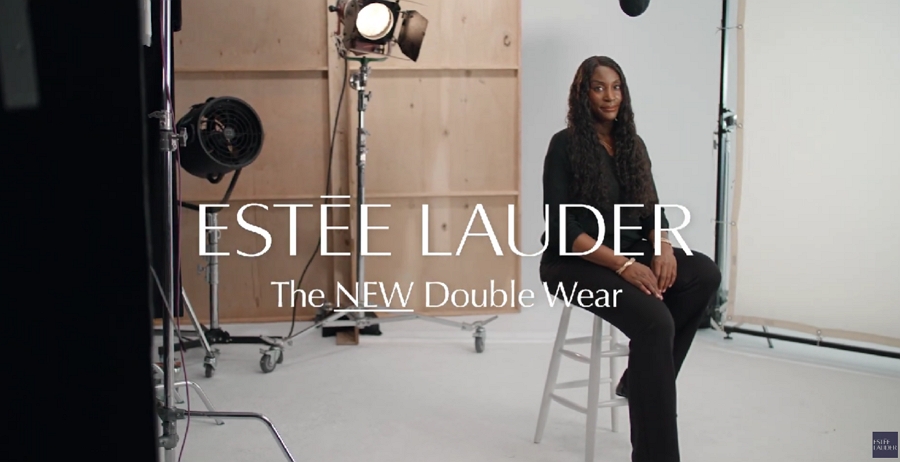
Localization goes beyond simply swapping words. A successful marketing video must feel natural to the audience in each target market while communicating the exact same brand message and campaign goal.
Achieving this requires more than just changing the language. Marketing teams must adapt product terminology, cultural references, measurements, pricing formats, and calls to action. A marketing hook that converts well in English can easily lose its impact—or sound completely awkward—when translated directly into another language.
Tone and delivery also require careful attention. While voice-preserving AI dubbing maintains the original speaker's vocal identity and energy across languages, human review remains essential. Regional marketers must ensure the translated messaging and delivery perfectly fit the local audience and campaign context.
The objective is not to make a video sound translated. The objective is to make it feel like it was created for that local market from the start.
Traditional studio localization often involves finding voice actors, booking studios, recording sessions, and post-production. AI dubbing introduces structural advantages for growth teams.
Your marketing assets represent your brand equity. Selecting the right platform prevents translation errors and protects your data. Choose the software based on these specific features.
Do not upload your video immediately and expect perfect results. Proper preparation prevents costly rework and protects your campaign launch schedule. Complete this prep checklist before production begins.
Moving a video through an AI dubbing pipeline is a straightforward process when you use a centralized platform like Vosko AI Dubbing.
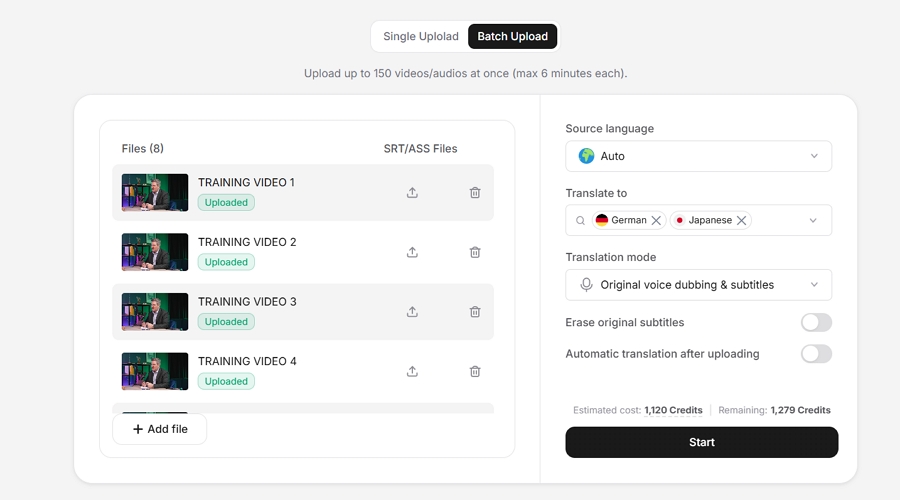
Import your final cut video into the Vosko dashboard. You can upload up to 150 videos simultaneously for large-scale campaigns. Then choose your regional languages. Vosko supports translation into up to 8 languages simultaneously to accelerate multi-region launches. After that, click Start to proceed.
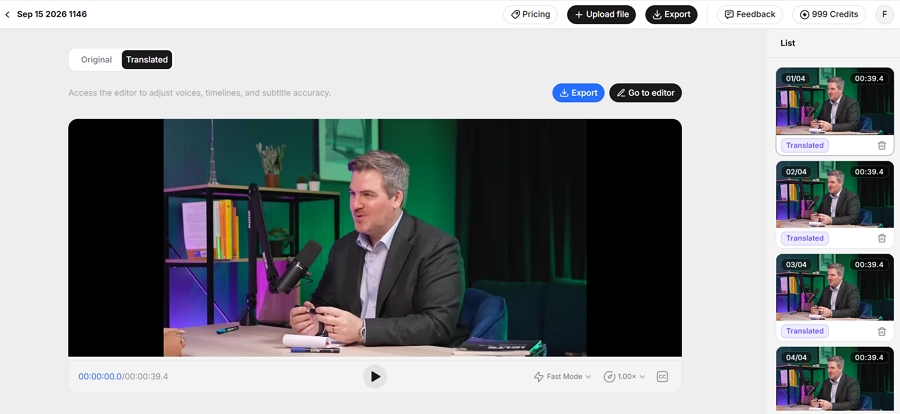
Wait for Vosko AI to finish translating your videos. Once the translation is complete, preview the results in the player. Vosko preserves the original speaker's accent, tone, and emotional delivery.
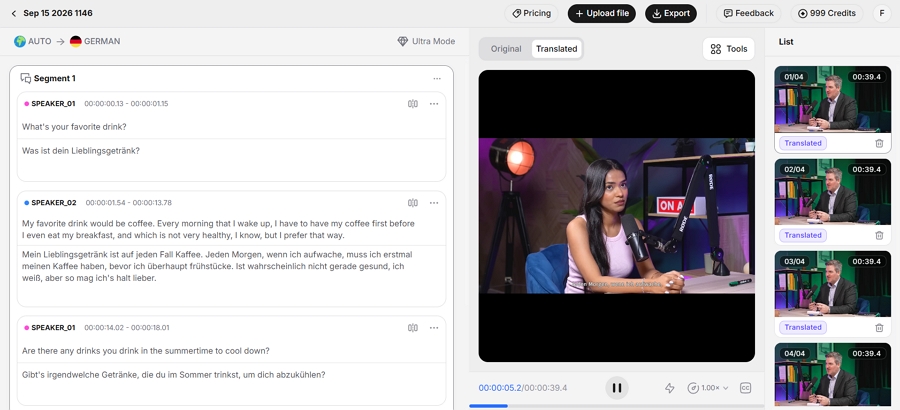
Have your regional team review the built-in text editor. Apply your brand glossary, convert regional measurements, and adapt the marketing hook where direct translation does not fit the target market.
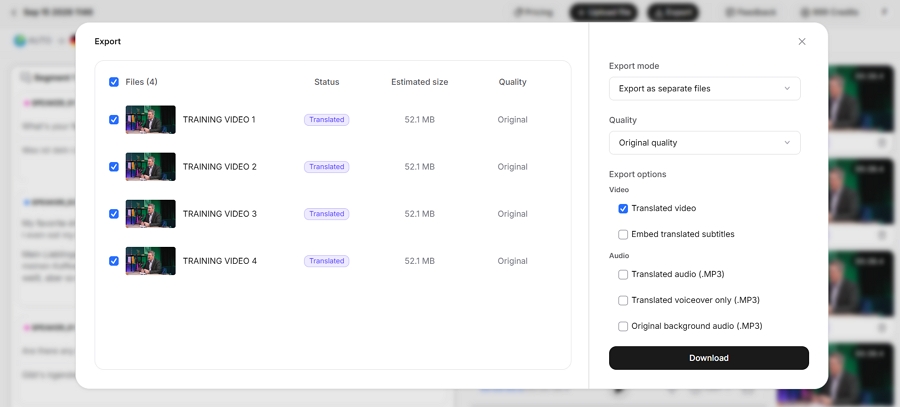
Export the final dubbed video, standalone audio, or subtitle files for your distribution and publishing workflows.
AI handles the heavy lifting, but human experts must govern the final output. Set up a strict internal review process before putting ad spend behind a localized video.
Divide the review responsibilities clearly. A native-speaking marketing manager should check the narrative flow and emotional hook. A product owner should verify that technical features remain accurate. The legal team should review any market-specific claims, and the brand team should approve the final vocal presentation.
Once approved, run structured A/B tests in your ad platforms. Compare dubbed and subtitled versions within the same target market, while keeping audience, placement, offer, budget, and creative format as consistent as possible.
Track specific performance metrics including View-Through Rate, Click-Through Rate (CTR), Conversion Rate, Cost Per Acquisition (CPA), and overall lead quality to determine which format delivers stronger engagement and conversion efficiency.
You do not need to localize your entire video library at once. Start with one high-value evergreen video in a priority market and measure the results before expanding. Once you validate the workflow, you can easily apply the same process to localize training videos, sales presentations, and onboarding content.
Measure changes in engagement and conversion against your existing baseline. Localize your marketing videos with Vosko AI Dubbing and test one high-value video before expanding to additional markets.
What is the workflow for localizing marketing videos with AI dubbing?
The process begins with uploading your final video and selecting target languages. The software transcribes and translates the dialogue. Your regional team then reviews and adjusts the script for cultural accuracy. Finally, the system generates the new voice audio, synchronizes it to the video pacing, and exports the final asset.
Should marketing teams use AI dubbing, subtitles, or both for localized videos?
Dubbing can be a better fit for product demonstrations, narrative-driven campaigns, and videos where viewers need to focus on the visuals rather than read subtitles. Subtitles may be more appropriate when production speed, accessibility, or silent viewing is a priority. The most reliable approach is to test both formats in the target market and compare campaign results.
How do you keep brand voice consistent when translating videos into multiple languages?
You maintain consistency by utilizing AI platforms that feature advanced voice preservation such as Vosko AI. Instead of replacing the original speaker with a different voice, voice-preserving systems can closely match the speaker's tone, pitch, and delivery in the target language.
What legal rights are needed before using voice cloning for marketing videos?
You should obtain explicit, documented consent before using a real person's voice for commercial voice cloning. Depending on the jurisdiction and contract, unauthorized use may create privacy, publicity, employment, or contractual issues.
How much does AI dubbing cost compared with traditional video localization?
Traditional localization costs vary widely based on language, voice talent, recording, translation, editing, and post-production requirements. AI dubbing typically uses subscription or usage-based pricing, which can make large-scale localization more predictable and easier to scale.
How can teams test whether dubbed or subtitled videos perform best in each market?
Teams should run isolated A/B tests inside their ad platforms. Serve the subtitled version to one audience segment and the dubbed version to another within the same country, keeping other variables like budget and targeting consistent. Track concrete metrics like Cost Per Acquisition and Video Completion Rate to evaluate performance.