You spend thousands of dollars and weeks of production time crafting the perfect marketing video. You publish it, run ads against it, and watch the views roll in. But if that video is only available in English, you are artificially capping your revenue and ignoring the vast majority of the internet.
A "good enough" English video is no longer a viable global strategy. The modern internet is highly fragmented, visually driven, and intensely local. Implementing a multilingual video strategy goes far beyond simple translation. You are adapting cultural nuances, sending strong signals to local search algorithms, and fundamentally removing friction from the global buying process.
In this comprehensive guide, we will break down the hard data behind multilingual ROI, compare the exact costs of traditional dubbing versus modern AI workflows, and show you exactly how to localize your video content step-by-step.
Most marketing guides talk about localization driving generic engagement. We need to talk about hard revenue, user acquisition, and market share. Before diving into execution, look at the proven numbers behind global video marketing.
| Key Metric | Business Impact | Source Reference |
|---|---|---|
| 76% of consumers prefer buying in native language | Relying purely on English alienates over seven out of ten potential buyers. | CSA Research |
| 40% will never buy from websites in other languages | Ignoring localization equals voluntarily surrendering your global conversion rate. | CSA Research |
| 80% of YouTube views originate outside the US | Video expansion is the only path to capture explosive international traffic. | YouTube Official |
| 80% higher completion rate with localized subtitles | Localization directly boosts algorithm recommendations and viewer retention. | Travod |
| 85% of social media videos watched on mute | Hardcoded translated subtitles are a strict necessity for mobile marketing. | Digiday Internal |
Many companies assume that because English is the default language of global business, an English-only video is sufficient. This is the biggest misconception in digital marketing today.
Your international audience will not struggle through a language barrier to hand you their money. According to Nimdzi Insights, 90% of global users will immediately skip a product if it lacks native-language support.
Video is the most emotionally resonant marketing medium available. When you provide native dubbing and accurate subtitles, you build instant brand trust and prove to the consumer that you value their specific market.
Video consumes the vast majority of internet bandwidth, but the true growth markets are no longer in English-speaking countries. Take YouTube as the primary example. It is the second-largest search engine in the world.
If your video lacks localized metadata, translated titles, descriptions, and SRT files, you are competing in a hyper-saturated English market while completely ignoring the rest of the platform's user base.
When you localize your content, you immediately tap into foreign-language long-tail keywords. This traffic has extremely low competition but highly specific search intent. It is the fastest way to rank on the first page of Google Video Search in Latin America, Europe, or Asia without spending a single dollar on additional advertising.
Localization is a technical SEO strategy that directly manipulates platform algorithms in your favor. Algorithms on YouTube, TikTok, and Instagram prioritize one core metric above all else: completion rate. Travod data proves that viewers are 80% more likely to watch a video to the end if they can read accurate subtitles in their language.
You also need to account for mobile viewing habits. With 85% of social media videos playing on mute, failing to provide precise native subtitles means you will lose your foreign audience within the first three seconds.
When algorithms detect this massive drop-off, they bury your video. Proper localization keeps eyes on the screen, which forces the algorithm to push your content to broader audiences.
Historically, companies hesitated to localize videos because the legacy process was a logistical nightmare. Hiring voice actors, renting recording studios, and managing manual translations for a 10-minute video could easily cost thousands of dollars and take weeks to complete. The break-even point was simply too high for routine marketing content.
That financial model is officially dead. The rise of specialized AI video translation has turned localization from a heavy cost center into a high-leverage growth engine.
Instead of dealing with expensive agencies or fragmented text-to-speech APIs, modern marketers use purpose-built AI platforms to automate the entire global pipeline. By leveraging advanced AI dubbing and translation, growth teams achieve three critical business metrics simultaneously:
You can now test five new international markets for less than the cost of what one localized video used to dictate.
Understanding how to allocate your budget means knowing exactly how your audience consumes content across different channels. Before committing to a workflow, you must evaluate the trade-offs between speed, cost, and viewer experience.
Here is a direct breakdown of how the three primary localization methods stack up against each other for modern digital marketing.
| Features | Subtitle Localization | Traditional Human Dubbing | Modern AI Localization |
|---|---|---|---|
| Localization Scope | Subtitles only (SRT / Burn-in) | Voice audio only (Requires separate subtitle vendor) | Voice Dubbing + Subtitles (All-in-one sync) |
| Workflow | Low (Text translation and file export) | Extreme (Casting, studio booking, mixing, agencies) | Automated (Single-click cloud upload) |
| Time to Market | Hours to 1 Day | 3 to 6 Weeks | Under 10 Minutes |
| Financial Cost | Very Low ($) | Very High ($$$$) | Low-Moderate ($$) |
| Original Voice & Audio Fidelity | Original voice intact, but no translated speech | Replaces original voice; often damages background music/effects | Clones original speaker's tone & preserves 99% background audio |
| Best Used For | Muted social media scrolling (Reels, TikTok) | High-budget cinema and television broadcasts | Scaling digital marketing, software demos, and YouTube growth |
Subtitles remain your baseline requirement. They are fast and budget-friendly. If you are running top-of-funnel ads on Instagram Reels or TikTok, translated subtitles are mandatory because most users scroll on mute. However, text alone fails to capture the emotional connection required for longer sales demos or software tutorials.
Traditional Human Dubbing is the legacy premium option. Hiring voice actors and audio engineers for a single language costs thousands of dollars and takes weeks. You should reserve this strictly for high-stakes broadcast commercials, as it is simply too slow for agile digital content workflows.
AI Localization represents the modern sweet spot for global scaling. It delivers professional voice cloning and synced subtitles at a fraction of the cost, allowing you to test multiple geographic markets simultaneously instead of betting your entire budget on one language.
As the comparison above demonstrates, AI is clearly the only scalable path for modern global campaigns. However, acknowledging the power of AI is only half the battle; the real challenge lies in execution. You need a technology stack that actually delivers on that promise without adding technical friction to your workflow.
Rather than cobbling together separate transcription, text translation, and voice generation tools, growth teams are moving to unified, purpose-built platforms. This shift completely eliminates the logistical nightmare of the past. Modern digital marketers now rely on dedicated solutions like Vosko to automate the entire global pipeline from a single workspace.
Vosko allows you to upload a single English video and automatically generate both localized audio and subtitles in up to 99 target languages. The true competitive advantage lies in its advanced voice cloning technology.
The AI analyzes your unique vocal cadence and generates the translated audio track in your original voice. It sounds exactly as if you are fluently speaking Spanish, Japanese, or German directly to your viewer.
Here is exactly how to use Vosko to localize your video automatically:
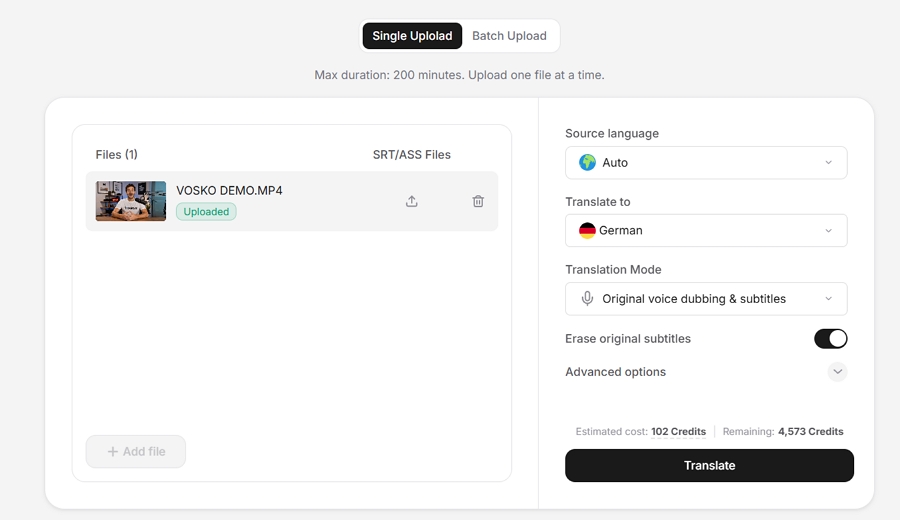
1. Import your original video file directly into Vosko's workspace.
2. Select your source language and then choose up to 8 target languages to translate simultaneously. This multi-language batching allows growth teams to test several international regions at once without multiplying the workload.
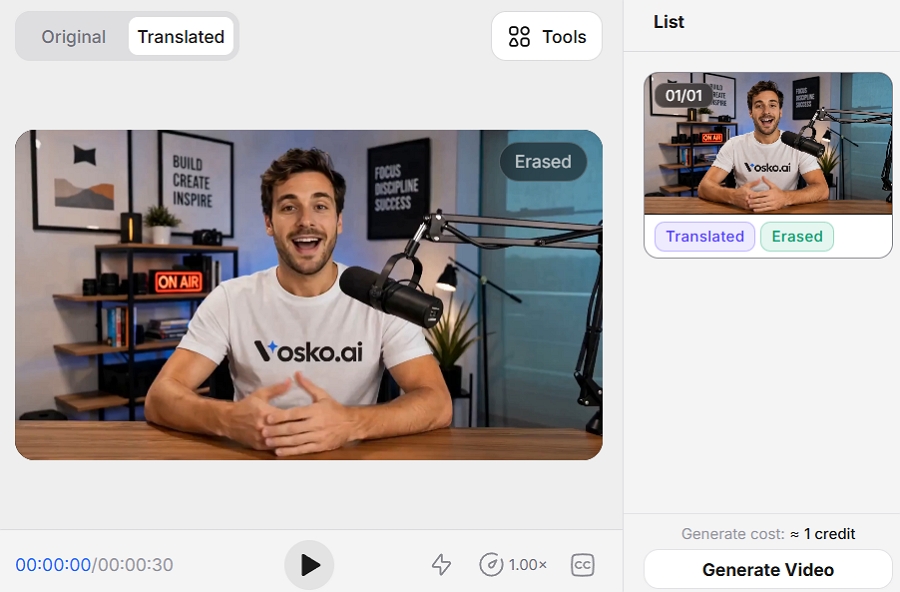
3. Wait a few minutes for the AI engine to process the translation. Once completed, you can instantly preview the translated videos to hear the cloned voice tracks and verify the subtitle synchronization.
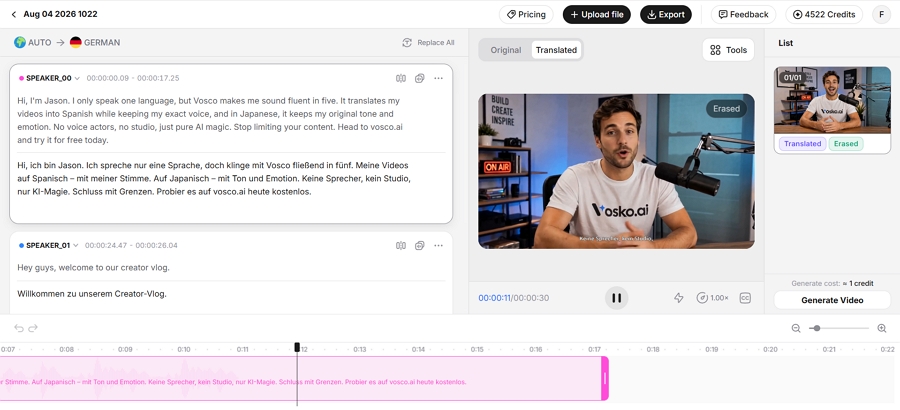
4. If you need to tweak a specific industry term, adjust a cultural nuance, or modify a subtitle timestamp, use the built-in timeline editor to make precise manual corrections.
5. Export your fully localized videos. You can download the complete video files for direct social media publishing or export separate SRT and audio tracks to maximize YouTube or other platforms SEO.
How much ROI can I expect from localizing my marketing videos?
Because AI tools allow you to enter low-competition markets with native-language content, businesses typically see their Cost Per Acquisition (CPA) drop significantly. Lowering upfront production costs makes localized campaigns profitable much faster than saturated English-only campaigns.
Which platforms benefit most from multilingual video optimization?
YouTube offers the highest search engine ROI due to its native support for multi-language audio tracks and localized metadata. TikTok and Facebook Ads follow closely, as native-sounding creatives directly improve ad relevance scores and lower bidding costs.
Is AI voice dubbing good enough or should I use human voice actors?
AI dubbing is now the standard for scaling commercial content. Advanced platforms clone the speaker's voice accurately, preserve emotion, and maintain background audio fidelity. For marketing promos, software tutorials, and social content, AI is highly effective. Human actors are typically reserved only for multi-million-dollar cinematic broadcasts.
What are the most common video translation mistakes to avoid?
The most critical mistake is burning translated text directly into the video without also uploading a separate SRT file, which destroys the SEO value for search engines. Another major error is using basic translation tools that strip away your background music and sound effects, ruining the video's production value.
Artificial intelligence has made video localization faster, easier, and more affordable than ever before. Adapting your video content is now the most direct, data-backed lever you can pull to decrease user acquisition costs and build trust with buyers around the world.
Stop leaving international revenue on the table. Evaluate your current video library, integrate modern AI dubbing into your marketing workflow, and convert your existing content into a worldwide growth engine.