Global expansion forces brands and creators to localize video content faster than ever before. Market data consistently shows that over 75 percent of global consumers prefer purchasing products or consuming media in their native language.
Tightening production budgets and the demand for rapid publishing mean video translation is no longer a simple choice between hiring an agency or skipping localization entirely. Understanding exactly why localize your video content dictates your budget allocation, content lifecycle, and ultimate viewer engagement in foreign markets.
If you need to move fast and test new markets, use automated AI dubbing. It provides unmatched speed, preserves the original creator's voice identity, and allows you to translate a single video into ten languages for a fraction of traditional costs. It is the mandatory choice for daily YouTube uploads, software tutorials, and social media ad testing.
If you are producing flagship brand commercials, theatrical trailers, or highly emotional documentaries, you must hire human translators and voice actors. Only humans can reliably transcreate deep cultural nuances, adapt local slang, and deliver the extreme emotional range required for premium cinematic content.
For professional creators and digital marketing teams wanting the best of both worlds, the industry standard is the hybrid model. This involves generating the base translation and cloned audio via AI, but utilizing human editors to tweak the script and timeline before final rendering.
Before analyzing the business impact, you must understand the mechanical differences in how these two pipelines function.
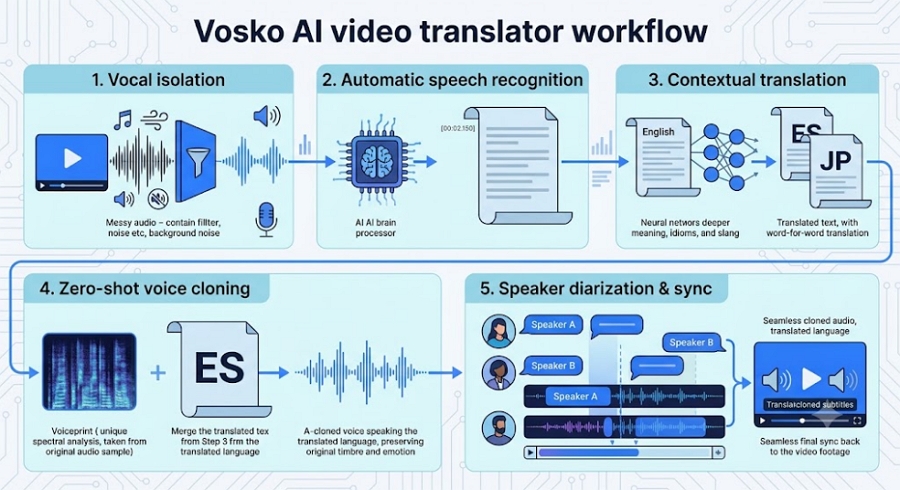
The AI dubbing workflow is highly centralized and automated. A creator uploads a video file to a software platform. The engine instantly separates the vocal track from the background noise and generates a text transcript using advanced Automatic Speech Recognition. Modern ASR engines now achieve human parity in clean audio environments, boasting Word Error Rates (WER) below 3%.
The system then runs machine translation, uses zero shot voice cloning to analyze the original speaker's tone, and synthesizes a new audio track in the target language. The entire process happens within minutes on a single dashboard.
Advantages of automated AI dubbing
Limitations of automated AI dubbing
The human translation workflow is a fragmented supply chain. A project manager exports the video script and sends it to a localization agency. Human translators rewrite the text to fit the target language and culture.
The agency then casts native voice actors, books recording studio time, and records the audio. Finally, an audio engineer manually aligns the new voice track with the original video cuts to ensure proper lip sync. This pipeline requires multiple software handoffs and typically takes weeks to complete.
Advantages of human video translation
Limitations of human video translation
To help you visualize the operational differences before diving into the details, here is a direct comparison of the two approaches across key production metrics.
| Production Metric | AI Dubbing Workflow | Human Translation Workflow |
|---|---|---|
| Turnaround Time | Minutes to hours | Weeks to months |
| Total Cost | Very low (SaaS credits plus minor editing labor) | Extremely high (Agency fees and studio rentals) |
| Voice Identity | Exact 1:1 voice cloning of the original creator | Requires hiring completely different foreign actors |
| Emotional Range | Standard to moderate (Requires manual style tags) | Flawless (Captures extreme subtext and breathing) |
| Cultural Adaptation | Literal translation (Struggles with regional memes) | Expert transcreation of humor and local slang |
| Agility and Rework | Instant (Regenerate a fixed sentence in seconds) | Slow (Requires rebooking actors for studio pickups) |
| Best for | Daily YouTube videos, software tutorials, UGC, corporate training, and social media ad testing | Flagship brand commercials, theatrical trailers, comedy specials, and legal compliance media |
Understanding the actual production pipeline reveals where time and money sink. The comparison goes far beyond simply reading translated text aloud.
Audience perception starts with the naturalness of the voice, and viewer retention is the ultimate judge of localization quality. Modern AI can achieve near perfect acoustic resemblance, replicating the unique timbre and pitch of the original speaker instantly. This preserves your brand identity across global markets.
However, audience tolerance varies heavily by content format. Viewers watching a tech review prioritize clear information and accept AI audio if the instructions are accurate. Conversely, audiences watching intimate daily vlogs or emotional documentaries are highly sensitive.
If a highly emotional video features an unnatural breathing pattern or a flat synthetic delivery, the uncanny valley effect triggers. Internal platform data indicates that YouTube audience retention drops sharply within the first ten seconds when viewers detect low quality synthetic audio because the lack of authenticity breaks viewer trust.
Human actors excel at interpreting subtext to maintain this trust. They naturally inject breath, hesitation, and emotional nuance into their delivery, bridging the gap between raw information and true storytelling.
Translation precision involves cultural transcreation and critical script length adaptation. Human translators understand double meanings and brand tone. If your English video references a niche American pop culture meme or uses specific Southern US colloquialisms, a human expert rewrites the joke to land perfectly with a Latin American or European audience.
Standard AI engines translate literally. They often fail to capture industry specific acronyms or subtle humor. More importantly, AI traditionally fails at script length adjustment.
According to standard localization industry metrics, translating English into Romance languages like Spanish or French expands the text volume by 20 to 30 percent. A literal AI translation forces the synthesized voice to speak incredibly fast to fit the original video timing, completely ruining the natural pacing.
When your content strategy requires launching a hundred tutorial videos into the US market simultaneously, turnaround time dictates your success. AI provides unmatched speed and scalability. A software engine processes hours of video in near real time. A human agency requires days or weeks to cast, record, and mix the same volume of content.
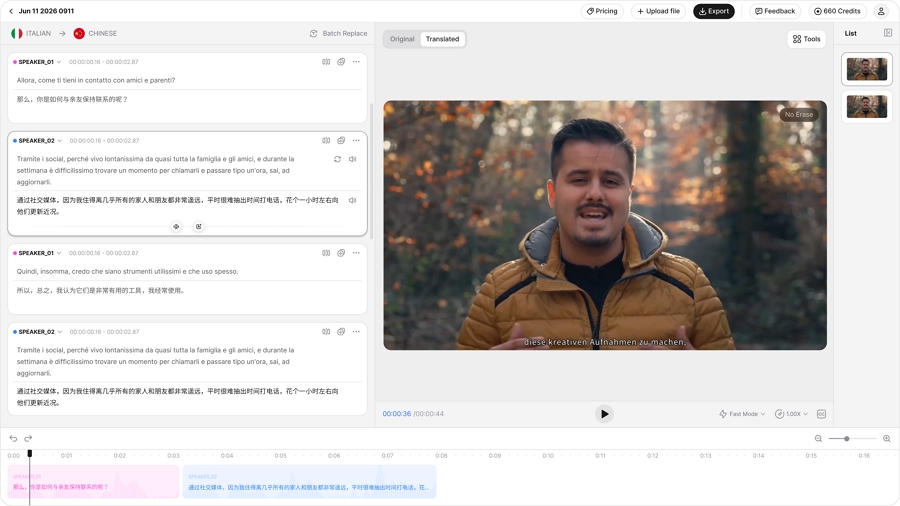
For batch processing scenarios like online courses or daily YouTube channels, human pipelines break down. They cannot scale without linearly increasing costs and extending deadlines. Modern AI dubbing platforms integrate directly into browser based timeline editors, allowing creators to adjust subtitles and export the final mixed video from a single workspace.
Evaluating the per minute price tag only shows half the picture. The true financial metric is the total cost of ownership. AI dubbing platforms such as Vosko offer an extremely low base cost, allowing marketers to run rapid split tests across multiple regions.
However, hidden costs lie in post editing requirements. To achieve broadcast quality, human editors must still review the AI generated transcript and adjust the timeline for perfect lip sync.
Human translation carries a massive upfront financial burden. Industry averages show that professional human translation, studio booking, voice acting, and audio mixing typically range from $50 to over $200 per minute of finalized video. The advantage is a much lower requirement for internal rework. The agency delivers a finished file ready for broadcast.
The most effective modern localization strategy blends both methods. The AI draft plus human polish workflow offers the perfect balance of speed, cost, and quality.
Professional teams use dedicated platforms like Vosko AI dubbing software to handle the heavy lifting. The engine transcribes the audio, translates the text, and clones the original voice instantly. However, before finalizing the video, human experts step in.
Using a collaborative timeline editor, native speakers review the AI generated text. They correct industry jargon, adapt cultural jokes, and shorten translated sentences to match the original pacing. Once the text is perfect, the AI renders the final voice track. This approach delivers near human quality at machine speed.
Make your localization decision based on strict project parameters rather than industry hype. Here are the ideal use cases for every workflow.
Does AI dubbing negatively impact YouTube search rankings?
No. YouTube algorithmically rewards high viewer retention and total watch time. If your localized video provides accurate and engaging content that keeps foreign viewers watching, YouTube will promote it exactly like native content. Many creators successfully use official tools like YouTube Auto Dubbing or third party AI software to add multiple audio tracks, which actually boosts global reach significantly.
Can AI translation tools match lip movements automatically?
Many premium AI video translators now include visual lip sync technology. The software slightly warps the speaker's mouth movements in the video file to match the newly generated syllables of the foreign language, significantly reducing the uncanny valley effect.
How much does traditional human video translation cost?
Pricing varies wildly based on language pairs and actor experience. However, industry averages show that professional human translation, studio booking, voice acting, and audio mixing typically range from $50 to over $200 per minute of finalized video.
Is it legal to clone a voice for commercial dubbing?
It is completely legal if you hold the explicit consent of the speaker. Reputable AI platforms require users to read a verification prompt aloud to prove they are cloning their own voice. Cloning a celebrity or a third party without signed consent violates severe copyright and biometric privacy laws.
The debate between AI and human video translation is no longer a battle of quality, but a question of resource allocation. AI has successfully commoditized the mechanical act of voice synthesis and standard translation, pushing the barrier to entry for global markets to near zero.
Smart brands do not choose one over the other. They deploy AI dubbing to aggressively capture long tail search traffic and test secondary global markets. Once a specific region shows high retention and strong return on investment, they selectively allocate higher budgets for human transcreation on their most critical assets. Mastering global growth means knowing exactly when to let the machine run fast and when to let humans take the wheel.