Localizing a video ad used to mean hiring a translator, voice talent, a studio, and an editor for every market. AI dubbing and platform tools have cut much of that production work, so the harder questions now come first.
Which ads deserve a second language? What has to change besides the words? How will you know it worked? Here is the process, from choosing markets to testing results.
To localize a video ad for global markets, start with one or two markets and an ad that already performs. Adapt its hook, offer, and CTA rather than translating them word for word, then translate and review the script and choose dubbing or subtitles.
Adjust the on-screen text, visuals, and landing page, check local rules and usage rights, and test each market separately. Localization can't rescue a weak concept, and results vary by market.
Localizing an ad goes well beyond translating the script. The language, wording, visuals, offer, and click-through path all have to suit the market. Three terms get used loosely:
| Term | What it means | Example |
|---|---|---|
| Translation | Converts the original text or speech into another language | Rendering an English voiceover in Spanish |
| Localization | Adapts language, visuals, pricing, and context to the target market | Changing currency, subtitles, CTA, and on-screen text |
| Transcreation | Recreates the message to keep its intent and persuasive effect | Rewriting a pun-based hook that doesn't translate |
Microsoft's guidance describes transcreation as a deeper rewrite than ordinary translation, one that keeps the original intent while making the message resonate locally. It costs more and takes longer, so it is usually reserved for slogans, campaigns, and commercials, and the source content should be final before it starts.
Language matters commercially, with a caveat. A CSA Research survey of 8,709 consumers in 29 countries, published in 2020, found that 76% of online shoppers prefer products with information in their own language, and 40% won't buy from websites in other languages. It measured online shopping, not video ads, so treat it as context rather than a forecast.
Translate the message accurately. Adapt the creative to the market.

Translating every video into every supported language is rarely the best first move. Decide where to localize and which ads to start with.
There is no universal starting list, so use your own data rather than a country ranking.
Start with ads that have a conversion record, such as a product demo, a creator ad, or a problem-solving video. Localizing a proven ad tests whether the concept travels, but it won't turn a weak one into a strong one. Begin with two or three ads in one or two markets, confirm the process works, then expand.
| Method | Best when | Watch for |
|---|---|---|
| Translated subtitles | Speech is simple, budget is tight, or you're testing a market | Reading time, line length, screen space |
| AI dubbing | You're extending existing ads to several languages | Translation, voice naturalness, and pacing still need review |
| Human dubbing | Performance and voice direction matter most | More recording, revision, and coordination per language |
| Transcreation or reshoot | The concept, talent, or setting doesn't fit the market | More planning and production work |
These methods combine, so an ad can have a dubbed voice and translated subtitles. Placement matters too. TikTok-commissioned research from 2021 found that 88% of surveyed users call sound essential to the platform, though the figure is self-reported, so check how each placement is actually watched. Our guides to subtitles vs. dubbing and dubbing vs. voice-over go deeper.
Replacing the voiceover, fitting it to the video's timing, and matching visible mouth movements are three separate jobs. A dub can sound natural without matching a speaker's lips.
Some platform tools offer lip-sync as an option, but TikTok's documentation says it doesn't work with multiple speakers, covered mouths, poor lighting, or background noise. Find out what a tool does before you promise it.
Ad platforms are building dubbing into their own workflows.
Access and controls vary by account and region, and TikTok's tool isn't available in Texas and Illinois. A separate AI dubbing tool makes more sense when one localized file has to run on several platforms or when you want more control over the script and audio mix.
These steps hold whether you work with translators, voice talent, or an AI dubbing tool. What changes is where the human effort goes. With AI, much of the production happens in one automated run, and most of your time shifts to adapting the message and reviewing the output.
Before translating, look at how local buyers and competitors describe the product, and which offers, prices, and terms apply. Then rework the parts of the ad that carry the persuasion:
Suppose an English ad opens with a pun on the product name. A literal translation keeps the words and loses the effect, so keep the selling point and write a new hook in the target language.
Then translate the script for the ear rather than the page. Keep product names and terminology consistent, confirm that claims, prices, and the CTA are accurate, and watch the timing, since translated lines can run longer or shorter than the original.
AI is useful for first drafts and repeat versions, but a fluent sentence can still be wrong. Have a native speaker review the markets that matter most.
Many AI dubbing tools transcribe the speech, translate it, generate the dub, and produce subtitle files in one run, so the question is less which to produce than which outputs to publish on each placement.
Choose by placement, content, audience, and budget. For a dub, listen for natural pronunciation, pacing that fits the cuts, distinct voices for each speaker, emotion that suits the ad, and music and effects that survive intact. For subtitles, look at line length, reading speed, and whether the text covers the product or interface.
Language changes shouldn't stop at the audio track. Check each layer of the ad and the page it leads to:
The click path matters as much as the video. A localized video can earn the click, but a page in another language adds friction right after it.
Do this before launch, not after.
AI disclosure rules are moving too. TikTok labels exported Symphony videos as AI-generated, and the EU AI Act applies its transparency obligations, including rules on deepfakes, from August 2, 2026.
Whether a particular AI-dubbed ad is covered depends on the content, so get qualified review before running voice-cloned ads of real people in the EU. Rules differ by country and industry, so rely on current official sources.
Watch each version the way a local viewer would. Can they tell what the ad sells right away? Do the pronunciation and pacing sound natural? Do subtitles display cleanly without covering key visuals? Are prices, offers, names, and CTAs consistent, and do they match the landing page? Is the text readable on a phone? Fix problems before you spend on tests.
| Step | What an AI tool usually handles | What you still own |
|---|---|---|
| 1. Message and script | Transcription and a first-draft translation | Hook, offer, and CTA rewrites; terminology; native review |
| 2. Dub or subtitle | Dubbed audio and subtitle files, often from one run | Choosing outputs per placement; checking voice, pacing, and subtitle fit |
| 3. Text, visuals, landing page | Sometimes burned-in text removal (varies by tool) | Prices, imagery, layout, landing page |
| 4. Rules and rights | Platform AI labels in some tools | Claims, voice and likeness permissions, disclosure |
| 5. Review | Fast regeneration after edits | Watching every version, approving, testing |
Order still matters. Settle terminology and any hook rewrite before you generate, because some platform tools limit script edits. TikTok's Symphony, for example, allows only minor corrections to the generated script.
Tools also differ in voice cloning, background-audio handling, speaker detection, and lip-sync, so test one language on one ad before you batch. For a tool-level walkthrough, see how to dub a video with AI.
Match each metric to the stage of the ad path it describes:
| Metric | What it tells you | Caution |
|---|---|---|
| CTR | Whether the ad earns clicks | Strong CTR with weak conversion may point to the offer, audience, or landing page |
| Video hold or completion | Whether people keep watching | Available metrics vary by platform and objective |
| Conversion rate | Whether clicks become the target action | The page and offer affect it as much as the video |
| CPA | Cost per conversion | Judge it against margin, not just other ads |
| ROAS | Attributed revenue per ad dollar | Attribution settings and returns can distort it |
Record a baseline for each market, compare versions under controlled conditions, change one main variable at a time, and wait for enough data before deciding. Analyze each market on its own budget, competition, and behavior.
In a Google case study, app developer Amobear used Google's Video Ads Dubbing tool for German- and Spanish-dubbed ads and reported a 45% lift in CTR and an 8% rise in ROAS for the German version. That is one advertiser's vendor-published result. It shows localized ads can be tied to business metrics, not what you should expect.
Disclosure: Vosko AI is our product. Details come from our official documentation, so confirm current limits before you plan a project.
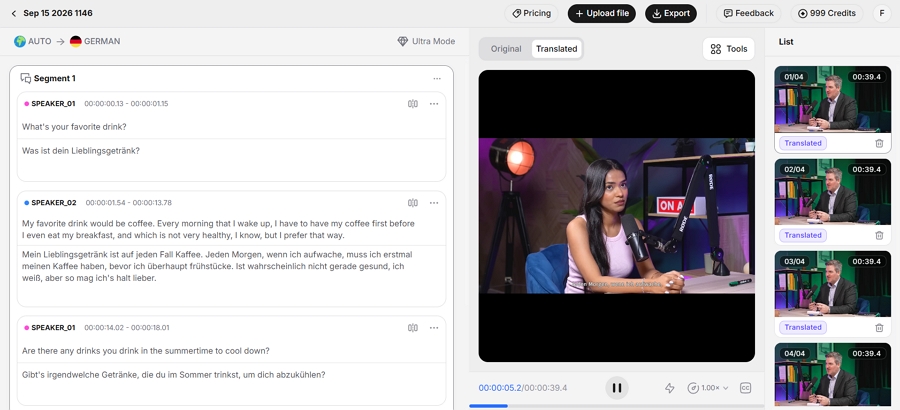
Vosko AI fits the dubbing and cleanup parts of Steps 1 to 3 when you already have a finished ad with a real speaker:
Vosko doesn't manage campaigns, review legal claims, or change on-screen mouth movements, so it's a weaker fit for close-up spokesperson ads that need visible lip matching. If you have a proven ad ready for a second language, try Vosko AI Dubbing on a short clip and run the result through the checks above.
How Is Video Ad Localization Different From Video Translation?
Translation changes the language of the audio or text. Localization also adjusts the hook, offer, CTA, visuals, and landing page so the whole path from view to purchase fits the market.
Can I Localize Video Ads Without Reshooting Them?
Often, yes. If the footage still suits the audience, dubbing, subtitles, and new text and price overlays cover most changes. Reshoot when the talent, setting, or concept doesn't fit.
Should I Dub Video Ads or Use Subtitles?
Many ads use both. Subtitles are simpler and fit clear visuals or tight budgets, while a dub earns its cost when the voice carries the message. See subtitles vs. dubbing for the trade-offs.
Do I Need to Localize the Landing Page Too?
Usually. An ad in one language that lands on a page in another adds friction after the click. Keep the language, price, offer, and CTA consistent across both.
How Much Does Video Ad Localization Cost?
There is no standard price. Video length, language count, review needs, the voice approach, visual changes, and any reshoot all move the total. Get quotes on the same sample ad and include review time, or check out our complete breakdown of 2026 AI Dubbing Pricing to compare traditional agency rates against modern software.
Good localization keeps what already works in an ad, the product message and the creative idea, and adapts the language, visuals, and buying context to the market. Start with ads that have a track record and a few priority markets, finish the review and testing, and let the data decide where to expand. If you're preparing existing ads for more languages and want the original speaker to stay recognizable, test Vosko AI on one of your own videos.