Dubbing and voice-over can both deliver a video's message in another language, but they handle the original audio differently. Dubbing replaces the spoken dialogue with a target-language performance.
Voice-over layers a voice track over the footage, either as narration or as translated speech, and the original speaker may or may not stay audible underneath. AI dubbing offers another route, using software to handle much of the translation and speech production.
If you're weighing dubbing vs voiceover, the right choice depends on your content, the viewing experience you want, synchronization needs, budget, and how many languages you need.
Traditional dubbing replaces the original dialogue with a new performance in the target language. AI dubbing uses AI-assisted translation and speech production to do something similar, and its voice preservation and synchronization vary by tool. Voice-over is narration over footage or translated speech layered on top, and in some workflows the original speaker stays audible at a lower volume. Choose dubbing when a fully localized dialogue experience matters. Choose voice-over when clear information delivery matters more.
Dubbing replaces the spoken dialogue in a video with a new recording in another language, so viewers hear the localized version instead of the original. Wikipedia's overview of dubbing notes that the term commonly refers to different performers speaking the dialogue in a new language for international audiences, as with films, television series, cartoons, and anime.
The translated script has to sound like natural speech and fit each scene's timing, so teams rely on adapters or dialogue writers rather than literal translation alone. Performers record under direction, editors align the takes, and mixers blend the new dialogue with the original music and effects.
Researchers describe three synchronization constraints: isochrony (the line fits the duration of the original), phonetic synchrony or lip sync (the words suit visible mouth movements), and kinesic synchrony (the dialogue matches body movement). Lip sync matters most in close-ups. Some vendors also describe phrase-sync dubbing, which fits timing without matching individual lip movements. So dubbing does not automatically mean lip-synced, and recording can happen in a studio or remotely.
The main advantage is a complete, directed performance, which is why films, animation, and scripted series rely on it. The trade-off is production load. Casting, scheduling, recording, and revisions repeat for every language, so cost and turnaround rise with the number of voices, languages, and sync requirements.
AI dubbing uses software to handle much of the work that traditionally involved translators, performers, and sound engineers. Research describes the standard design as speech recognition, machine translation, and text-to-speech in sequence, with added steps to control the length and timing of the translated speech. A typical workflow looks like this:
Products differ in how they handle the voice. Some use a selected stock voice, some use voice cloning or speaker matching, and others focus on preserving recognizable characteristics of the original speaker, such as tone and delivery.
What AI has changed. Much of the effort has moved from scheduling performers and booking studios to reviewing the script and listening to the generated audio. Adding a language can mean running the same source through the same workflow instead of starting another casting and recording cycle, which makes large libraries more practical. The technology is also in everyday platforms. YouTube's auto dubbing covers 27 languages, with Expressive Speech aimed at carrying over a creator's tone in eight of them, and creators can review dubs before they publish.
The limitations are real:
AI dubbing is not automatically better, cheaper, or faster. A single high-stakes scene may be simpler with human actors, while hundreds of tutorials usually are not.
Voice-over is a broader production term than dubbing. It describes a voice added to a film or video, usually prerecorded and placed over the picture, and it is generally distinguished from dubbing because it is added alongside existing dialogue rather than replacing it. In practice it covers two situations.
Narrative voice-over. A narrator explains or supplements the visuals. Documentaries, corporate explainers, product demonstrations, tutorials, and educational videos commonly use it. It does not necessarily replace any dialogue, and the footage may have none.
Translated voice-over. A translated voice track is placed over footage in which someone speaks another language. In an established form often called UN-style voice-over, the original audio remains audible in the background at a reduced volume. The technique is used in documentaries and news reports to translate foreign-language interviewees, and it remains a standard localization technique on Polish television.
Terminology is not fully settled. Some vendors use voice-over as an umbrella term for any translated spoken audio that replaces or overlays the original track, which would include dubbing. This article uses the narrower sense above. When you request a quote or evaluate a tool, ask whether the original audio stays audible and whether timing or mouth movements are matched, rather than relying on the label.
Voice-over works well when conveying information matters more than recreating a performance. It usually involves fewer voices, needs no lip sync, and revisions typically mean re-recording one narrator.
The limits are less immersion for dialogue-driven stories, reduced clarity when original and translated speech overlap, and difficulty representing several speakers with one narrator.
| Comparison Criteria | Traditional Dubbing | AI Dubbing | Voice-Over |
|---|---|---|---|
| Definition | Human actors replace the dialogue | AI translates and generates replacement speech | Voice track added over footage |
| Original dialogue | Removed; new dialogue mixed with original music and effects | Usually replaced; background handling varies by tool | Narrative: untouched. Translated: lowered or removed |
| Voice and performance | New cast; directed performance | Stock, cloned, or speaker-matched voice | Narrator or translator voice |
| Typical workflow | Translate, adapt, cast, record, mix | Upload, translate, review, generate, export | Script, record, overlay, mix |
| Lip synchronization | Project-dependent: strict or timing-only | Timing fit is common; mouth matching is a separate capability | Not required |
| Production time | Longest: casting, studio, retakes | Shorter preparation; review time varies | Moderate: script plus narrator session |
| Relative cost | Highest per language | Varies with tool pricing and review load | Often lower than full-cast dubbing |
| Revisions | Re-record with performers | Edit text and regenerate | Re-record the narrator |
| Multilingual scalability | Scales with cast and studio capacity | Built for volume; limited by language support and review capacity | Moderate: one narrator per language |
| Main advantage | Immersive, directed performance | Efficiency across languages and libraries | Clarity and simpler production |
| Main limitation | Time, cost, coordination | Terminology errors; review required; timing is not lip sync | Less immersive; overlapping audio can reduce clarity |
| Best-fit content | Films, drama, animation | Creator content, training, marketing, large libraries | Documentaries, news, explainers, instruction |
Prices vary too widely to give a reliable universal figure, so compare what each method requires. The main cost and time drivers are video duration, number of languages, number of speakers or performers, script adaptation, revision rounds, sound engineering, and whether visible lip matching is required.
Three differences matter most:
Work starts with a transcript. A translator drafts the script, an adapter reshapes it to fit timing and, where needed, mouth movements, and casting matches voices to characters.
A voice director guides recording sessions, editors align the best takes, mixers balance the dialogue against the original music and effects, and a final review checks translation, timing, and sound.
Coordination adds time at casting, scheduling, and retakes, but a director can also steer emotion in ways a script alone cannot.
The steps listed earlier run mostly in software, so human time shifts to three checkpoints: reviewing the translated script, listening for pacing and speaker consistency, and fixing segments that run long or short before export.
Automation reduces scheduling and recording, but it does not remove quality control. A fast first pass still needs a careful listen.
For narrative voice-over, a writer prepares narration against the picture and a narrator records it. For translated voice-over, translators write a script meant to be read aloud and condensed for timing.
An editor places the recording against the footage, and a mixer decides whether the original audio is removed or kept beneath at a lower volume. Reviewers check that both tracks are intelligible and that the translation reflects what the speaker meant.
Match the method to the experience your audience expects, the type of content, and the number of versions you need.
Feature films, television dramas, animation, and other narrative content ask viewers to follow characters for a long time. A flat voice breaks the illusion, so casting, voice direction, adapted scripts, and detailed synchronization can justify the extra work.
It is not necessary for every video with a visible speaker. A founder giving a product update to camera rarely needs the treatment of a film scene.
AI dubbing suits content that already exists and must reach many markets: YouTube and creator videos, podcasts and interviews, product demonstrations, marketing videos, e-learning courses, corporate training, software walkthroughs, and large libraries. The advantage is localizing existing recordings without a new recording session for each language.
A generic AI voice may be enough when speaker identity does not matter, while creators, founders, and instructors may prefer tools that aim to keep the speaker recognizable. Suitability depends on source-audio quality, translation needs, speaker complexity, product capabilities, and the review time you can afford.
Documentaries, news and interviews, corporate presentations, educational explainers, and training videos often work well with voice-over, because the audience needs to understand the content more than experience a full dialogue replacement.
Original-audio handling depends on the approach. Audible source speech under a translation signals authenticity, while a narrated tutorial may remove it.
The previous section matched content to methods. These five criteria help when your project does not fit neatly into a category.
If viewers should forget they are watching a translation, as with drama or animation, a full localized performance matters.
If they only need to understand, as with a tutorial or news segment, clear narration is enough. Audible original speech signals authenticity, while full replacement feels smoother.
Ask whether speech only needs to fit the scene's timing or whether viewers will see mouths closely. Narration over screen recordings usually needs timing only.
For close-ups, you may need a workflow with verified lip-sync capabilities. A tool can fit a sentence into the right duration without changing a single mouth movement.
Compare the work, not just the invoice: performers, direction, and studio time for human recording; software usage and review time for AI dubbing; script, narration, and mixing for voice-over.
The cheapest option depends on complexity, language count, and revision rounds, so price a representative sample.
One video in one language rewards craft. Hundreds of videos in several languages reward repeatability. At volume, repeated recording, translation review, version management, and post-launch revisions grow fastest. Pilot with a small batch before committing a library.
For creators, founders, and instructors, the voice is part of the brand. Others prefer a director shaping delivery line by line, or approval of every sentence before audio is generated. Decide how much continuity and control you need, then confirm the tool or vendor offers it.
| If your priority is... | Consider... |
|---|---|
| Fully localized dialogue and detailed performance control | Traditional dubbing |
| Efficient multilingual production at scale | AI dubbing |
| Clear narration or translated speech over existing footage | Voice-over |
| Retaining recognizable source-voice characteristics in localized videos | An AI dubbing tool specifically designed for this purpose |
| Precise visual mouth synchronization | A production workflow with verified lip-sync capabilities |
Treat these as starting points rather than rules. The final choice also depends on the specific production and the tools available.
AI dubbing is a production workflow, not a guarantee of perfect localization. Before you publish, check the following:
Looking to translate videos without losing the speaker's unique delivery? Vosko AI Dubbing serves as a dedicated platform for authentic, high-quality video localization.
Vosko is the ideal option to transform content into multiple languages while preserving the original presenter's vocal character and emotional energy.
At its core, Vosko offers:
This makes it highly practical for e-learning teams, marketers, and podcast producers where the presenter's original energy matters. Instead of settling for generic AI voices or booking studio time, teams can deliver a natural, localized viewing experience with full control over the final export.
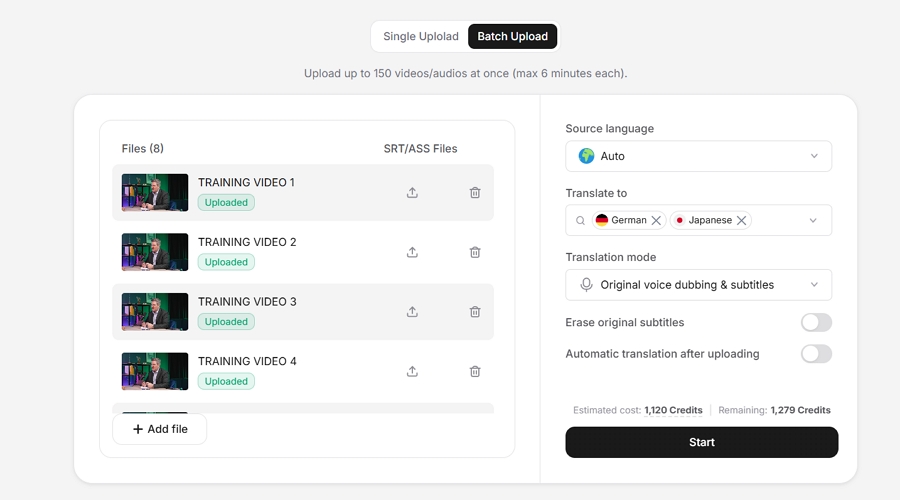
Vosko handles heavy workflows effortlessly. It supports single videos up to 200 minutes long and allows batch processing of up to 150 short clips at once, generating up to eight target languages in a single task.
Is AI Dubbing the Same as Voice-Over?
No. Voice-over describes how the audio is presented: a voice track layered over footage. AI dubbing describes how localized speech is produced, using software for translation and speech generation. AI tools can serve either workflow, so check whether a tool replaces the original dialogue or lays translated speech over a lowered original track.
Is Dubbing Always Lip-Synced?
No. Lip sync is one of three synchronization constraints researchers describe, alongside matching duration and body movement. It matters most in close-ups where mouths are visible. Many dubs, especially for training and explainer videos, fit timing without matching mouth shapes.
Is Voice-Over Cheaper Than Dubbing?
Often, but not always. Voice-over usually needs fewer performers and no lip sync. Final cost still depends on duration, language count, narrators, script adaptation, revisions, and mixing, so a complex translated voice-over can cost more than a simple AI dub.
Can AI Dubbing Preserve the Original Speaker's Voice?
Some tools can, and it depends on the product. Generic AI voices make no attempt to resemble the speaker, while voice-cloning or speaker-matching systems aim to keep recognizable characteristics. Results vary by language and source audio, and cloning someone's voice should happen with their permission.
Which Is Better for YouTube Videos and Podcasts?
It depends on the content. Channels built around a personality often benefit from keeping the speaker's voice recognizable, while educational channels may be fine with a clear narrator. Podcasts add multiple speakers, so test how a tool separates voices and consider translated voice-over or subtitles for heavy crosstalk.
Can I Use Dubbed Audio and Translated Subtitles Together?
Yes. Subtitles help viewers who watch muted, need accessibility support, or want the text, while dubbed audio serves viewers who prefer to listen. Whether you can produce both from one project depends on the product. If you edit the dubbed script, update the subtitle text to match.
Does AI Dubbing Automatically Remove Background Music and Sound Effects?
Not necessarily. Some tools separate speech from background audio and replace only the dialogue, while others replace the whole track or layer new speech on top. Check how the tool treats music and effects, and whether you can export the background audio separately.
What Affects the Cost of AI Dubbing?
Typical factors include video duration, language pair, number of speakers, the processing mode you choose, how many revisions you make, and how much manual review your team does. Extra synchronization or editing work, such as adjusting timing or fixing terminology, adds to the total.
Do I Still Need Human Review When Using AI Dubbing?
Yes, especially for important content. Reviewers catch mistranslated terms, mispronounced names, cultural missteps, and wording that does not fit your brand. The more a video affects sales, learning outcomes, or legal accuracy, the more a final human check is worth.
The choice comes down to a few practical distinctions:
Whichever route you take, the answer to the dubbing vs voiceover question follows from the viewing experience you want, the content format, synchronization requirements, budget, and how many versions you need. If your priority is multilingual localization that keeps the original speaker recognizable, you can explore Vosko AI and test it on one of your own videos.